
GVWR, axles and deck length, filtered properly.
A trailer buyer knows what they need to pull and what they need to haul. The catalog has to let them narrow on that from a phone, and your staff has to be able to list a unit the day it lands.
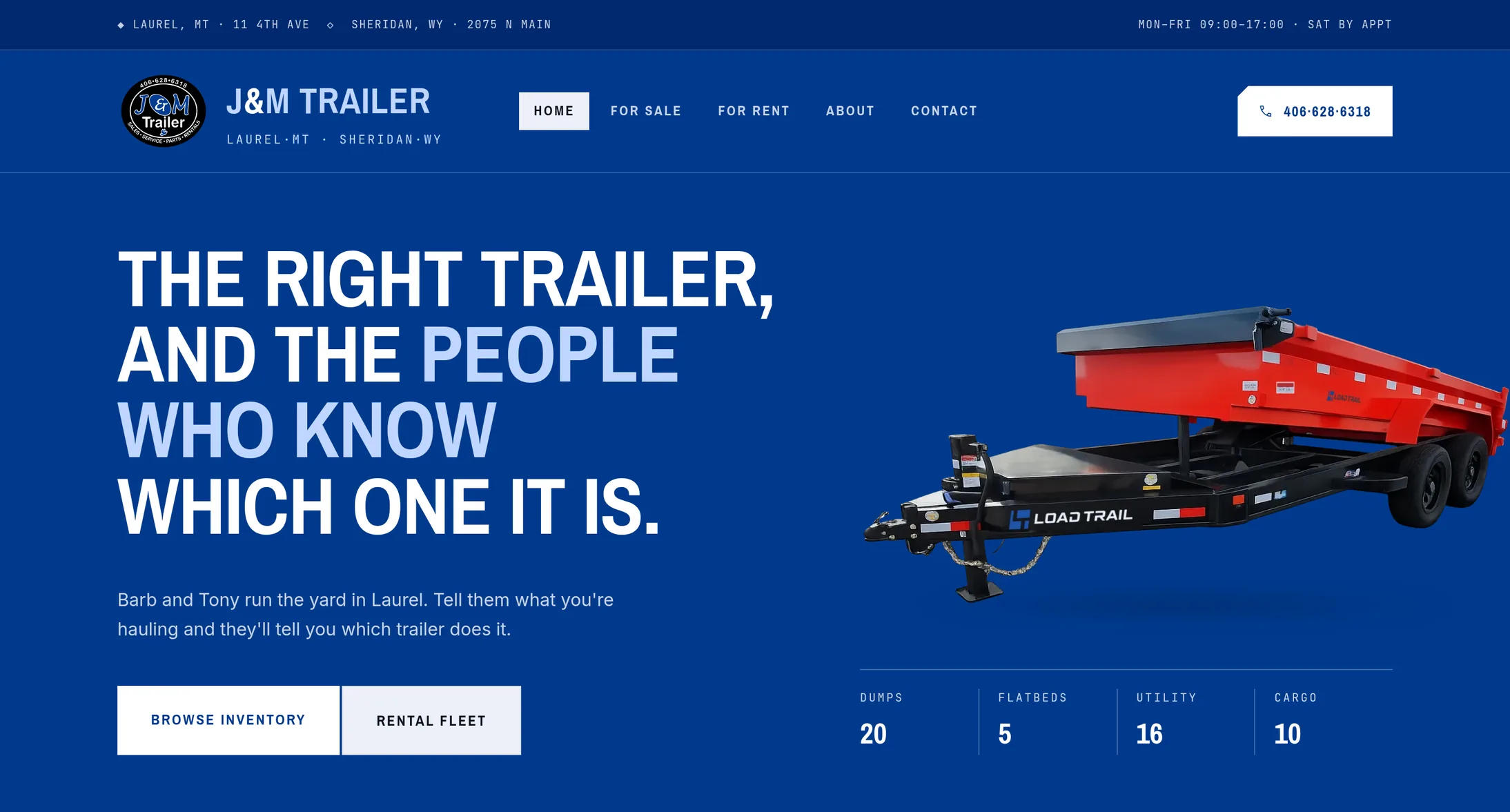

Featured client dealerships running on this platform today, with their own staff adding units, setting prices and shooting photos at the lot.
J&M Trailer migrated to this platform from a national dealer website provider, managing live multi-location inventory across Delta, Criterion and Load Trail product lines.
What a trailer listing has to carry
Structured inventory data that lets buyers filter by size, hitch style, and hauling capacity.
GVWR and empty weight, both
Buyers need to know exact towing limits. Providing both ratings lets buyers confirm payload capacity immediately without guesswork.
Deck length and width as numbers
Not '20 footer' in the description. Numerical dimensions enable precise catalog filters, making it easy for buyers to filter by length and width.
Distinct hitch types
Bumper pull, gooseneck, and pintle hitches are fundamental categories. Commercial buyers searching for goosenecks need to filter out bumper-pull trailers immediately.
Filters that stack
Under a GVWR, tandem axle, over 18 feet, all at once. Stackable filters let customers narrow a large lot down to exact matches in seconds.
Lot photography from any phone
Walk the lot, capture the deck, coupler, tires, and VIN plate, and upload directly from any smartphone without transferring files through a computer.
Units that move between lots
Transferring trailers between yard locations is a simple field update on a single inventory record, avoiding duplicate entries across lots.
- GVWR
- 14,000 lb
- Axles
- Tandem
- Deck length
- 20 ft
- Hitch
- Gooseneck
A trailer lot's fields, in the admin every dealer on this platform runs.
What your buyers actually type
Real buyer searches that lead directly to matching inventory units on your lot.
Featured client builds
Each write-up covers the screens, the admin behind it, and what the staff actually does with it.
Two locations across two states, with sales, rentals, service and parts in one system, and a live inventory shared with another dealer.
Laurel, Montana and Sheridan, WyomingSEE THE BUILD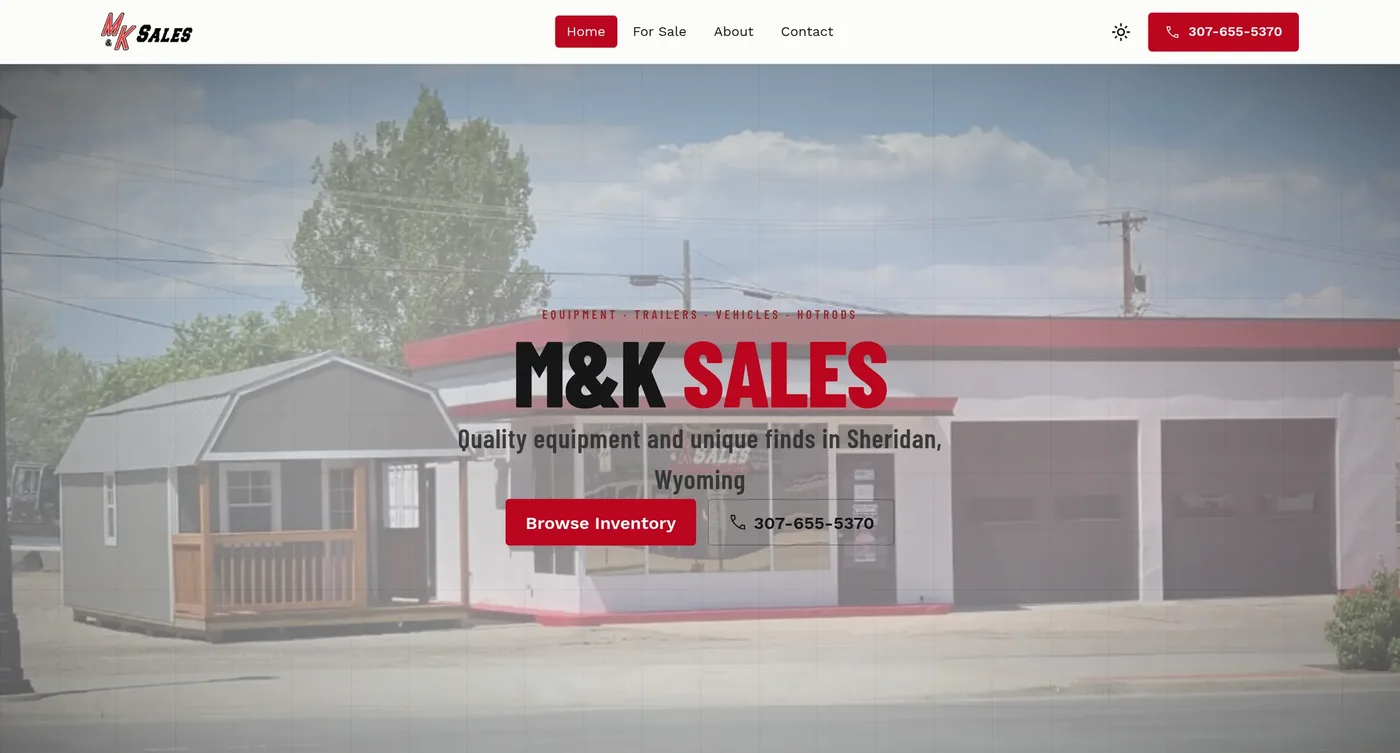
Equipment, trailers and the occasional hot rod, with multi-location inventory and cross-lot transfers handled in the same admin.
Sheridan, WyomingSEE THE BUILD9 QUESTIONS
Frequently asked questions
Common questions about trailer inventory management, spec filters, and switching platforms.
ASK SOMETHING ELSE01Can buyers filter trailers by size and dimensions like 7x14 or 8.5x20?
Yes. Deck length and width are structured numerical fields rather than plain text. Listing titles format automatically from year, brand, dimensions, and body style, while dimension filters allow buyers to jump straight to exact sizes like a 7x14 enclosed cargo trailer or an 8.5x24 car hauler.
02Can buyers filter between bumper pull, gooseneck, and pintle hitches?
Yes. Hitch type is an independent filter on the inventory catalog. Commercial buyers searching for gooseneck or fifth-wheel trailers can isolate those units instantly, while bumper-pull shoppers filter by ball size and weight ratings without sorting through incompatible hitches.
03Can buyers filter inventory by GVWR, axle count, and payload capacity?
Yes. GVWR, axle ratings, and calculated payload capacities are dedicated data fields. Buyers can filter specifically for 7,000 lb, 10,000 lb, or 14,000 lb GVWR classes to ensure a trailer matches their tow vehicle and commercial hauling requirements.
04How does VIN decoding work for commercial trailers?
Entering a VIN triggers a lookup against NHTSA's public vehicle database to automatically populate manufacturer, model year, and body style. Because trailer manufacturer coding schemes vary, fields that cannot be verified with certainty remain blank for your staff to confirm rather than filling with inaccurate guesses.
05How are trailer options like hoists, spreader gates, and ramps displayed?
Measured technical ratings and equipment options are presented in distinct sections on each listing. Specifications like GVWR, axle ratings, and deck height appear in a clean table, while features like scissor hoists, spreader gates, slide-in ramps, and tarp kits display as prominent badges.
06Can we list truck beds, parts, and accessories in the same catalog?
Yes. Body style includes truck beds alongside trailer categories, allowing flatbeds, service bodies, and accessories to be listed, photographed, and priced in the same admin. Listings adapt their spec tables automatically so non-trailer items never display irrelevant fields like coupler size or deck length.
07We rent trailers as well as sell them. Can the website handle both?
Yes. The platform supports both sales and rental inventory. Rental trailers display tiered rates for daily, weekend, weekly, and monthly periods, while keeping rental and sales listings organized in separate catalog views.
08Can inventory feed into third-party classifieds or marketplace tools?
Yes. The platform generates structured inventory feeds compatible with third-party classified syndicators (such as LotVantage) and Meta commerce catalogs for Facebook and Instagram. This keeps your external listings updated with current pricing and availability without re-entering inventory across multiple sites.
09How are pre-owned and used trailers showcased to buyers?
Used trailers carry a dedicated condition badge alongside high-resolution walkaround photo galleries highlighting the deck, coupler, tires, brakes, and frame. Staff can easily reorder photos so the strongest angle leads the listing, while title status and maintenance notes provide complete transparency.
Get your lot quoted.
How many units, how many locations, and what your current site cannot do.